


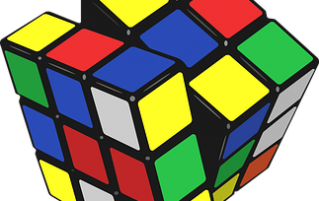
Our reaction time is the time it takes for us to respond to something happening. In this time, our senses notice something and send a signal back to the brain, the brain then comes up with an appropriate response and sends a signal down to our muscles to carry out an action. Que Jiyani from Fujian in China was 13 years old when he achieved a World Record for his quick reactions. After training for two years, he managed to juggle three Rubik’s cubes in the air, solving them at the same time!!! He managed to achieve this in 5 minutes 6.61 seconds.
Some animals have really fast reaction times. The Dracula ant has an amazingly quick mandibular snap. It accelerates from 0 to over 200 mph in 15 microseconds in order to stun prey. Or how about the mantis shrimp, which has a spear-like structure. This allows it to deliver a strike in under 80 microseconds, creating a shockwave underwater to stun prey. Also, the common housefly reacts in 20 to 50 milliseconds in order to avoid predators. No wonder it is so difficult swatting a fly!
For help with this try our new guides “How to work with Required Practicals: Part 4 and Part 5”. Part 4 focuses on the Biology practicals needed for Combined Science and Biology Paper 2 (AQA). Included in Part 5 are all the additional practicals needed on both papers for AQA Biology.
Part 4 includes:
Reaction Times, Investigating Population Size
Part 5 includes:
Preventing Bacterial Growth, Plant Response, Decay


If you found this useful and think you would benefit from some additional help, please contact us.

